
money matters
| how to save for your cycling tour | Most people are curious
about how we managed to save enough money to be able to quit our jobs
and embark on a multi-year cycling tour. Did we get rich during
the dot.com boom years? Perhaps we inherited a large sum from a
long lost relative? Maybe we got lucky playing the lottery? Nothing of the sort. We lived simply and saved.  Eric is a penny-pincher at heart so saving comes naturally to him. I, on the other hand, was more like the average western consumer. After many years of self-indulgence--lots of expensive clothes, nice car, trendy restaurants and the like--I set off traveling and discovered that cutting back on spending doesn't meaning cutting back on the enjoyment of life. Much to the contrary. I now enjoy each small pleasure much more intensely. Here are some of the ways we vastly reduced our spending:
Here are some things we didn't give up (and they didn't hinder us from saving money):
Finally, If you really want to set out on a bike tour, you will find a way to save money. We've met families on the road, recent graduates who've never worked full-time and retired people enjoying the freedom of travel. Take the steps needed to make your dreams come true. Start now. Like this site? Want to support us as we bike around the world? Just do all your AMAZON shopping through the link below.. 
|
| planning a budget | Planning
a budget is a tough task if you have little experience touring or
budget traveling. If you are planning a long tour, it may help to
categorize the countries you'll be visiting into
high, mid-range and low cost destinations. Most people would put
Europe, North America and Australia and Japan in the high cost
category. Mid-range countries might broadly include Eastern
Europe, the Middle East, South Africa, Argentina, Chile and Brazil and
other second world countries.
Your low cost countries are those most popular with budget
travelers and backpackers. Places like India, Thailand, Bolivia
and Egypt. Keep in mind that just because a country is poor doesn't mean that it's necessarily a cheap place to travel. Countries that are recovering from a civil war (Congo, Angola) are notoriously expensive as are those that cater to high-end tourists (Botswana, Namibia, Mozambique). The cheapest countries are usually those that are relatively stable and have a good-sized middle class and attract budget travelers. While a poor country poor doesn't always equate a cheap travel destination, the same also holds true for developed countries. Traveling in Europe doesn't have to be expensive. By shopping at discount supermarkets (prolific all over the continent) and either couchsurfing or free camping you can easily get by on $5 per day. Free internet access is available at many tourist information bureaus so that is another expense you can cut out. But a trip to the gelateria or a beer on the terrace in a touristy spot could easily eat up half of your $5 a day budget, so you must be very disciplined. |
| managing your money on the road | Managing your money on the road is much easier than it used to be.
Today, most countries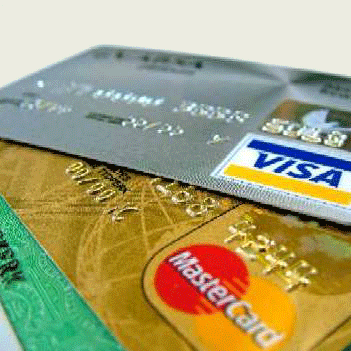 s
are linked up to an international ATM
network and you can get cash easily. No need to spend the morning
cashing traveler's checks or hunting down an exchange bureau. A
VISA card is slightly more useful than mastercard some countries are
only linked to the Visa network. Check the back of your bank
cards to see which international networks such as Cirrus or Plus your
card is linked up to. s
are linked up to an international ATM
network and you can get cash easily. No need to spend the morning
cashing traveler's checks or hunting down an exchange bureau. A
VISA card is slightly more useful than mastercard some countries are
only linked to the Visa network. Check the back of your bank
cards to see which international networks such as Cirrus or Plus your
card is linked up to. It's always best to leave home with several bankcards. We've had our account at one bank blocked because they noticed unusual spending patterns. This could have been a real nightmare, but fortunately we had back up cards. In addition to your bank cards, it's a good idea to carry a few hundred dollars worth of traveler's checks. We've been carrying around the same ones for years and they don't expire but we feel reassured knowing they're there. A supply of cash is also good to keep on hand in developing countries. We always carry US dollars and euros for changing in out of the way places. And there are still some countries that are not yet hooked up to international ATM networks, for example Sudan.  At
most borders in the developing world, money changers will be lurking
around. You may even see signs expressly prohibiting their
presence and warning travelers that changing money is illegal. So
far we've never had any problems. While changing money in Zambia,
an immigration officer merely asked us to hurry up as it looked bad to
be flaunting the law. At
most borders in the developing world, money changers will be lurking
around. You may even see signs expressly prohibiting their
presence and warning travelers that changing money is illegal. So
far we've never had any problems. While changing money in Zambia,
an immigration officer merely asked us to hurry up as it looked bad to
be flaunting the law.It's always best to be discrete. In our experience, money changers are more or less honest . It's unlikely that someone will try to outright rob you, but keep a sharp eye out when the counting is taking place. Crowds tend to gather during negotiations which can make you nervous, so insist on doing business with one man only. Getting a good rate is tough. Check the internet before you cross the border to know what the going rate is. Then you'll have to bargain hard because these guys are pros. Sometimes we exchanged directly with people going the opposite direction. This was a win-win situation, cutting out the middleman. Be sure to set up internet banking well before you plan to set off. You will need to get pin codes and this may take time.
|
| cost-cutting while you travel | When we began our bike tour in 2006, we were already experienced
budget travelers, having backpacked in Asia in 1995-1996 and
through South America 2001-2002. We though we knew a lot about
traveling on the cheap. Now we know more.  Backpacking
in Asia and South America we stayed in cheap guest houses geared
towards the backpacking crowd and ate at
local restaurants. We were still able to maintain our budget,
spending
around 10 US dollars per person per day including transport costs.
Taking that into consideration, We assumed that on our cycling
tour through Africa a similar budget of 10 euros
per person per day would be a cinch to maintain. In fact, we had
to tighten the belt to keep under the 10 euro target. Here are
some expenses we didn't reckon with in Africa: Backpacking
in Asia and South America we stayed in cheap guest houses geared
towards the backpacking crowd and ate at
local restaurants. We were still able to maintain our budget,
spending
around 10 US dollars per person per day including transport costs.
Taking that into consideration, We assumed that on our cycling
tour through Africa a similar budget of 10 euros
per person per day would be a cinch to maintain. In fact, we had
to tighten the belt to keep under the 10 euro target. Here are
some expenses we didn't reckon with in Africa:First of all, visas are very expensive in Africa. We spent more than 1,000 dollars each on visas in the first 17 months of our trip through West Africa to Cape Town. Secondly, food is also relatively expensive in Africa. If you want anything other than the local staple, it often must be imported. At first we thought shop owners were just trying to rip us off. How could a tomato cost more in Senegal than in France? Double European prices for a bar of chocolate? You must be kidding. From bread to biscuits, high relative prices are something to be reckoned with in much of Africa. Agriculture in many parts of Africa is either for subsistence only or run by large foreign-owned commercial farms who export directly to Europe and North America. You won't find markets overflowing with cheap fruit and vegetables as you will in Asia and South America. We also found out that accommodation can take a big bite out of your budget in many developing countries. Countries without a large middle class don't have hotels geared towards budget travelers. They will have hotels for expat workers, rich locals and well-heeled package tourists, but not for you, or the local man who want to spend less than 10 dollars a night on a room. It goes without saying that hotels cost a pretty penny in the developed world. In Europe, even campsites can set you back $10 - $20 per night depending on the location and level of comfort. So, what's the solution? How can you keep costs down on your cycling tour? Obviously you can't cut corners on visas. What's left? Food and lodging. For a cyclist it's unthinkable to cut calories. You can't just eat less. But you can cut out restaurants. Of course that means you're missing out on some of the cultural experience of tasting the local cuisine. It's a trade-off. Travel longer or indulge in a little paella or risotto once in a while. The solution for most long-term travelers is to self-cater in countries where eating out is expensive and indulge once they hit a low-cost country. The easiest and least painful way for you to cut costs will be to reduce spending on accommodation. Lodging was a killer for us on the first part of our trip through Europe and West Africa before we learned to free camp and enjoy the hospitality of hosts from Couchsurfing and Warm Showers. Once we started using Couchsurfing regularly and free camping more often, we cut our average costs by about 40 percent, from around 10 euros per day per person to just 6 euros per day per person. We weren't cycling through countries where traveling was cheaper, we were just traveling more wisely. |
| How to free camp and still get a good night's sleep | Free camping or wild camping
is very common amongst touring cyclists. Most cyclists find no
greater joy than to pitch their tent in an open field or hide away in
the forest enjoying the solitude and peace of the great outdoors. But some people, myself for one, worry about a psychopath sneaking up at night and interrupting their slumber. Or they've got a hang-up about bathing and can't stand going a few days without a shower. Well, I've finally seen the light and am now a converted free camper. You can be too. First off all, free camping doesn't mean you have to compromise on safety or just as important, feeling safe. Honestly, I don't believe there's much chance of encountering problems if you hide away in some quiet spot where you're unlikely to be discovered. But I still don't like to do this too often because I don't feel safe. A part of me still wonders if there's a crazy man observing us from afar. If you don't feel safe, you won't sleep well and you'll spend a miserable next day pedaling through the world. For me it's just not worth it. Our version of free camping is to get permission to camp on someone's land, or public place such as a church, mosque, school, police station, health center, municipal building or NGO. Sometimes we even 'camp' at hotels. We like this style of free camping for several reasons. First, we feel safer because there are other people nearby or better yet, a night watchman to stand guard. Secondly, water is usually readily available and often we have access to a shower and toilets. And lastly, we often find really nice places to camp that are like having a big park all to ourselves. Finding a pleasant place to free camp is really not very difficult and you'll find that most people will say 'yes' to your request, even in Europe. If you want people to let you, a stranger on a bicycle, spend the night on their land, you must first establish confidence and trust. We always start by explaining our mission-- a cycling tour around the world to raise money for charity. We have a printed explanation of our mission with a map. People normally like the idea of a cycling tour around the world and want to help us. One farmer in Italy, who initially told us to go to a guesthouse 5 kilometers down the road, ended up opening up a small weekend house on his farm, gave us the keys and told us to help ourselves to anything in the fridge and cupboards. He had come to trust us and wanted to help, in fact helping us made him feel good. Here are some ways you can increase your chance of getting a 'yes' to your request:
Your request to camp in an African village will most likely never be turned down. Muslims take hospitality very seriously, so in countries like Sudan, Syria and Turkey you will also be welcomed warmly. In these countries locals will probably insist you sleep inside with the family, as having someone sleep outside in a tent would be a sign of bad hospitality. Overall, we also found people in Balkan countries quite receptive to our free camping requests. 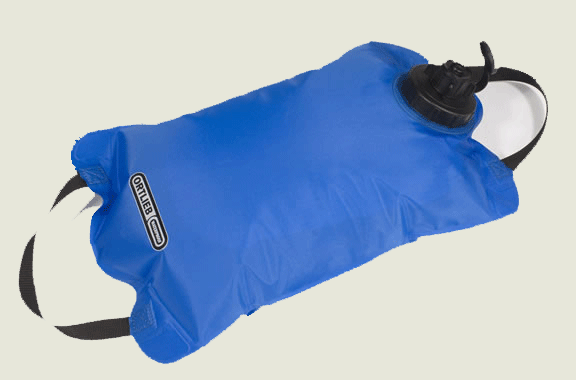 There
are occasions where we pitch our tent in a hidden spot on the side of
the road. This is almost always in the desert. The desert
doesn't scare me too much because there's no place for a mad man to hide
in the desert. Logical, isn't it. But, desert camping requires
water. Not a problem if you've got an Ortlieb water bladder.
We carry two and fill them up when we know that we'll be wild
camping. They're easy to strap on to the back panniers and the
extra weight doesn't make much of a difference if you're cycling on
flat terrain. There
are occasions where we pitch our tent in a hidden spot on the side of
the road. This is almost always in the desert. The desert
doesn't scare me too much because there's no place for a mad man to hide
in the desert. Logical, isn't it. But, desert camping requires
water. Not a problem if you've got an Ortlieb water bladder.
We carry two and fill them up when we know that we'll be wild
camping. They're easy to strap on to the back panniers and the
extra weight doesn't make much of a difference if you're cycling on
flat terrain. |
| Couchsurfing and Warm Showers: how to make friends and cut costs. | Couchsurfing and Warm Showers
are worldwide on-line networks for making connections between travelers
and the local communities they visit. Couchsurfing is for all
travelers and Warm Showers is a special network of people who want to
host touring cyclists. Both  services
are entirely free and you have no obligation to host people in your
home country. Although no doubt you will want to because it's so much
fun. services
are entirely free and you have no obligation to host people in your
home country. Although no doubt you will want to because it's so much
fun.Couchsurfing and Warm Showers are not just about free accommodation, though that is a bonus. It is the best way to travel and actually meet people and get into the culture as you travel around the world. Staying with complete strangers does sound a bit odd at first and I must admit we were on the road more than a year and a half before we had the courage to try out couchsurfing. I only wish we hadn't waited so long. We've connected with so many fascinating people and really had the chance to see the world from so many different perspectives. Plus staying at someone's home is a nice break from life on the road. What a pleasure to switch on the coffee machine in the morning, relax in a steaming hot bath, prepare a meal together in a well-equipped kitchen. Pure bliss after roughing it in the tent. Log on to couchsurfing now, set up your profile and start making friends around the world. |
